
Is SEO Still Worth Learning in 2026? What the Zero-Click Data Says
Yes, SEO is still worth learning in 2026, but the job has changed. Fewer searches end in a click than in 2024, and AI answers now sit above the results. The people who do well are the ones who learn SEO together with the newer skills of answer engines and AI search, and who work where searches still lead to a visit, a call or a sale.
This post looks at what the numbers say, with sources, so you can decide for yourself.
Key takeaways
- 68.01% of Google searches in the US ended without a click in the first four months of 2026, up from 60.45% in 2024.
- Google still handles about 98% of searches in India.
- When an AI Overview appears, the top-ranking page gets about 58% fewer clicks.
- Local and shopping searches still send people to businesses, and AI assistants drive only about 1.6% of search traffic and revenue for online stores.
- The average SEO Specialist in India earns about ₹3.53 lakh a year, and mid-career pay averages about ₹5.29 lakh.
What the zero-click data says
A zero-click search is one where the person gets what they need on the results page and does not visit any website. SparkToro's 2026 study, based on Similarweb clickstream data, found that 68.01% of Google searches in the US ended this way between January and April 2026. In 2024 the figure was 60.45%.
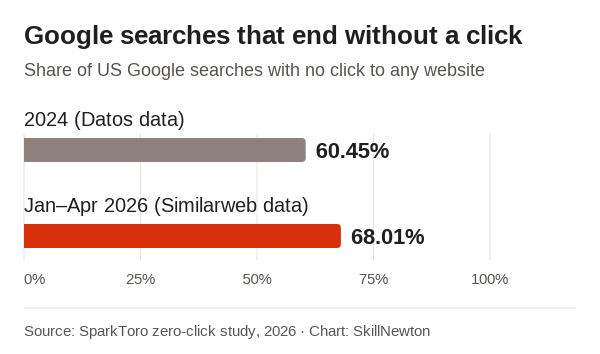
That is a real change, and it is fair to feel uneasy about it. It still leaves close to a third of searches ending in a click, on a search engine that people use many times a day. The study also covers the US only, and SparkToro notes that its figures from different years use different data providers, so year-to-year comparisons are approximate.
The practical lesson is that ranking is no longer enough by itself. You need to rank for searches where people still want to click, and you need your brand to be the one named in the answer when they do not.
Google still owns search in India
Some people ask whether search itself is fading. In India it is not. StatCounter's figures for October 2026 put Google at about 98% of the search engine market, with Bing at about 1%.
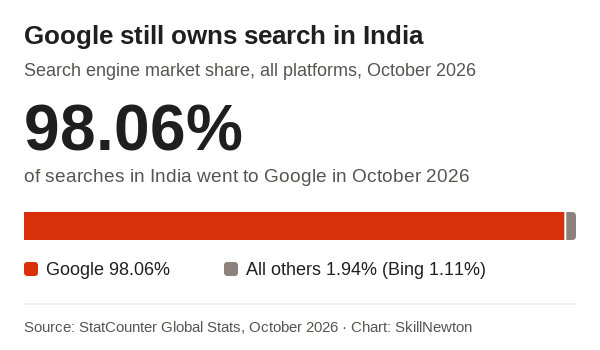
Google is also where much of the AI search activity happens. Google said at I/O 2026 that its AI Mode had passed 1 billion monthly users. So for an Indian business, being found still means being found on Google, in both the classic results and the AI answers.
What AI Overviews do to clicks
AI Overviews are the AI-written summaries at the top of many Google results. Ahrefs re-ran its click study with December 2025 data and found that when an AI Overview appears, the page ranking first gets about 58% fewer clicks than expected. Its earlier study, in April 2025, had put the drop at 34.5%.
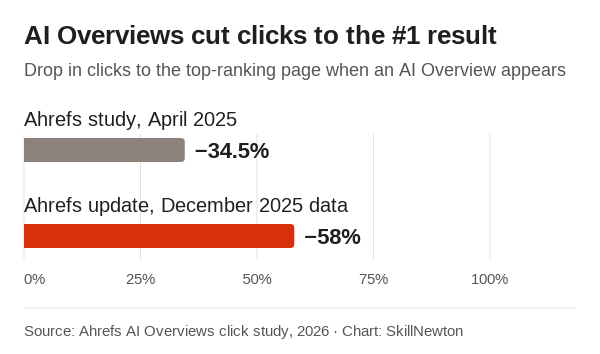
A short summary can fully answer a simple question, so pages that only define a term or explain a basic step are the most exposed. That is why the work is moving towards searches with a purpose behind them: finding a nearby business, comparing products, choosing a service.
Where SEO still pays
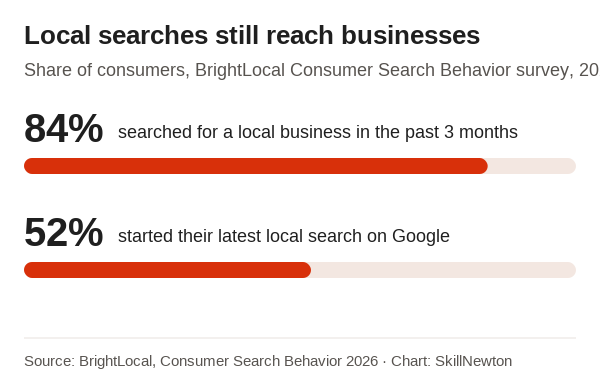
Local search. People looking for a clinic, a restaurant or a repair service still act on what they find. BrightLocal's Consumer Search Behavior research for 2026 found that 84% of consumers had searched for a local business in the past three months, and 52% began their most recent local search on Google. A business that appears in Google Maps with good reviews gets calls and visits, whether or not anyone clicks through to its website.
Online stores. Shoppers still click, because they have to reach a product page to buy. Search Engine Land's review of e-commerce data found that non-branded organic search is one of the top revenue channels for online stores, second only to paid search, and that AI assistants bring only about 1.6% of search traffic and revenue across a panel of 75 e-commerce sites.
So the demand for people who can rank a local business or an online store has not gone away. These are also the two areas where a freelancer can find clients most easily, because the result is measured in calls and orders.
What SEO pays in India
Payscale's 2026 data for India puts the average base salary of an SEO Specialist at ₹3,53,178 a year. The range runs from about ₹1.75 lakh at the lower end to about ₹7.71 lakh at the higher end.
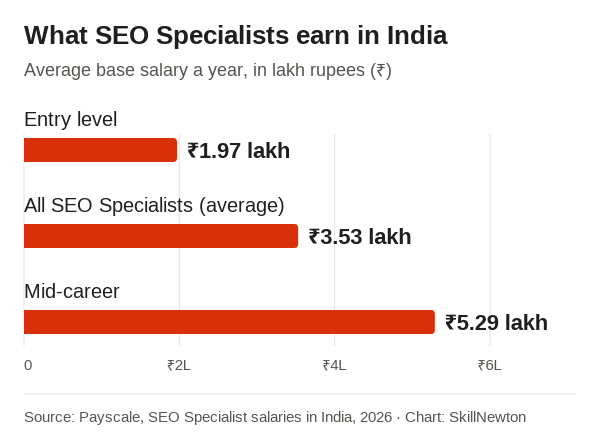
| Experience | Average base salary a year |
|---|---|
| Entry level | ₹1,97,251 |
| All SEO Specialists | ₹3,53,178 |
| Mid-career | ₹5,28,808 |
These figures come from salaries that employees report to Payscale, so treat them as a guide. Pay also depends on the city, the employer and what you can show you have done.
The skills to learn now
Learning SEO for 2026 means learning six things, in this order:
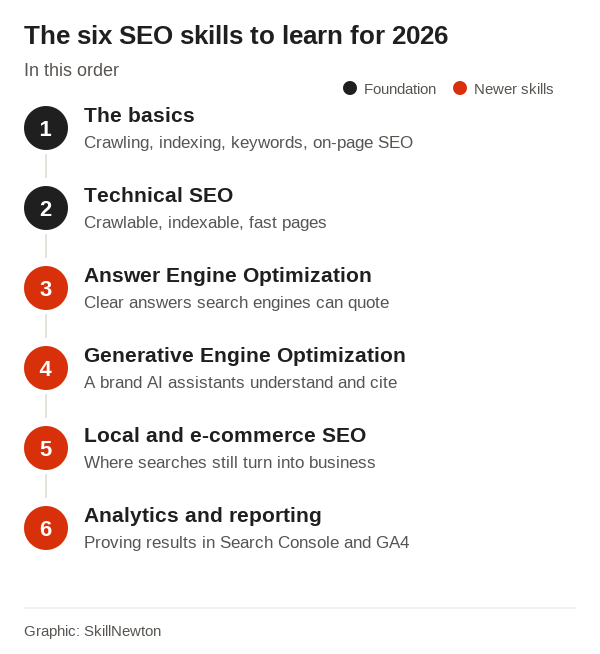
- The basics: how search engines crawl, index and rank, keyword research and on-page SEO. Our SEO Basics guide is a good starting point.
- Technical SEO: making sure pages can be crawled, indexed and loaded quickly.
- Answer Engine Optimization: writing clear, direct answers that search engines can quote. See our AEO guide.
- Generative Engine Optimization: making your brand easy for AI assistants to understand and cite. See our GEO guide.
- Local and e-commerce SEO: the two areas where searches still turn into business.
- Analytics and reporting: proving what your work achieved, in Search Console and GA4.
The first two are the foundation. The rest are what separate someone who learned SEO five years ago from someone who can do the job today.
How to start
Pick one website and practise on it. Reading alone will not make you employable; a site you have set up, optimized and tracked will.
If you want a guided route, SkillNewton's SEO Foundation & Practical Implementation course is 30 live classes for ₹4,999, and you apply every lesson to a live WordPress website. It includes introductory modules on AEO and GEO. For the full path from basics to AI search, automation and freelancing, see Advanced SEO, AEO & GEO Mastery. If you already know your direction, there are separate courses for Local SEO and E-commerce SEO.
No course can promise rankings or a job. What a good one gives you is practice, feedback and work you can show.
Frequently asked questions
Is SEO dead in 2026?
No. Google still handles about 98% of searches in India, and close to a third of Google searches still end in a click. What has declined is the easy traffic from simple information questions, which AI answers now handle.
Will AI replace SEO jobs?
Nobody can say for certain. What the data shows today is that AI has changed the tasks: less time on basic content, more on technical work, local and e-commerce SEO, and getting brands cited in AI answers. People who learn those skills are doing work that AI search has created.
How long does it take to learn SEO?
You can learn the working basics in about six weeks of weekday practice. Becoming good takes longer, and comes mostly from working on real websites.
Is SEO a good career for freshers in India?
It is an accessible one. It needs no coding to start, entry-level pay averages about ₹1.97 lakh a year according to Payscale, and pay rises with experience and proof of results.
Sources
- SparkToro: In 2026, Less than One Third of Google Searches Still Send a Click, reported by Search Engine Land: Google zero-click searches reach 68% in early 2026. Source for 68.01% and 60.45%.
- Google: I/O 2026: Welcome to the agentic Gemini era. Source for AI Mode passing 1 billion monthly users.
- StatCounter Global Stats: Search engine market share in India. Source for Google's share of about 98% in October 2026.
- Ahrefs: Update: AI Overviews Reduce Clicks by 58%, February 2026. Source for the 58% and 34.5% figures.
- BrightLocal: Local SEO statistics, citing its Consumer Search Behavior research, 2026. Source for 84% and 52%.
- Search Engine Land: 9 ecommerce search trends that actually matter in 2027. Source for the 1.6% figure and the ranking of organic search among revenue channels.
- Payscale: Average SEO Specialist salary in India, with its entry-level and mid-career pages, 2026. Source for all salary figures.
Related posts
How Long Does SEO Take to Work? What the Ranking Data Shows
SEO usually takes three to six months to show results, and longer in competitive fields. Here is what Google says, what the ranking studies show, and a realist…
Read postSEO Course Fees in India 2026: What You Pay and What You Get
SEO course fees in India run from free to well over ₹1 lakh. Here are the fee bands with sources, the costs that are easy to miss, and a checklist for comparin…
Read postSEO Salary in India 2026: Fresher to Mid-Career
What SEO Specialists and SEO Executives earn in India, from fresher to mid-career, with the latest Payscale and AmbitionBox figures and the skills that raise p…
Read post