
How Long Does SEO Take to Work? What the Ranking Data Shows
SEO usually takes three to six months to show measurable results, and up to a year or longer in competitive fields. Google's own guidance is four months to a year. Those are averages for sites that do the work properly. Most new pages never rank at all, and the difference lies in what you target and how you build the page.
This post sets out what Google says, what the ranking studies show, and a realistic month-by-month timeline.
Key takeaways
- Google's guidance is that an SEO needs four months to a year to make improvements and see the benefit.
- In polls answered by 3,680 people, the most common answer was three to six months (Ahrefs).
- Only 1.74% of newly published pages reach Google's top 10 within a year, down from 5.7% in 2017 (Ahrefs).
- Of the pages that did reach the top 10, 40.82% got there within one month.
- 72.9% of pages in the top 10 are more than three years old.
What Google says
Google has answered this question directly. In a 2017 video on how to hire an SEO, Google's Maile Ohye said that "in most cases, SEOs need four months to a year to help your business first implement improvements and then see potential benefit", as Search Engine Roundtable reported at the time.
That range covers two stages. First the changes have to be made: pages fixed, content written, technical problems solved. Then Google has to crawl the changes, reassess the pages and adjust rankings. Neither stage is instant, and the first often takes longer than people expect.
Practitioners broadly agree. When Ahrefs polled people on LinkedIn and X, the 3,680 who answered most often said three to six months.
What the ranking data shows
The averages sound reassuring. The page-level data is harsher.
Ahrefs took one million pages first seen by its crawler in September 2023 and checked whether any reached the top 10 within a year. Only 1.74% did. In the same study in 2017, the figure was 5.7%.
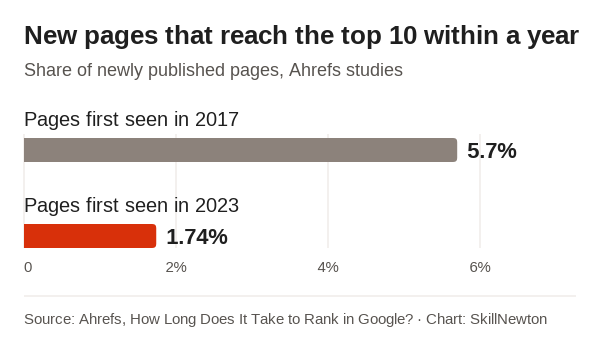
| Finding | Figure |
|---|---|
| New pages that reach the top 10 within a year | 1.74% |
| The same figure in 2017 | 5.7% |
| Top 10 pages that are more than three years old | 72.9% |
| Top 10 pages that are under one year old | 13.7% |
| Pages that reached the top 10 and did so within one month | 40.82% |
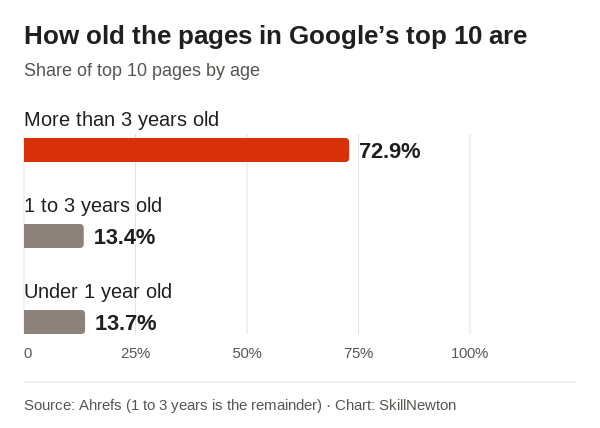
Two things stand out. Older pages hold most of the first page, so a new page is competing with pages that have had years to earn links and trust. And the pages that do break through tend to do it quickly: four in ten of them ranked within a month.
That second point changes how to read the timeline. SEO is less a slow, steady climb for every page and more a sorting process. Pages aimed at the right keyword with the right content can rank fast. Pages aimed at the wrong one may never rank, however long you wait. Ahrefs suggests that if a page is not in the top 10 after about six months, it is time to update it instead of waiting.
Why SEO takes time
- Google has to find and process the page. Crawling, rendering and indexing come before any ranking.
- New sites have no track record. Google has little evidence about a new site, and that evidence builds up over months. Google's John Mueller has said it can take up to a year for Google to work out where a new site should rank, as Ahrefs notes.
- Competitors have a head start. Most top results are years old.
- The work itself takes time. Research, writing, fixing and getting changes made by a developer all add weeks.
- Links and mentions arrive slowly. Other sites link to you only after they find you useful.
A realistic SEO timeline
This timeline is a guide for a new or small website doing consistent work. It is not a promise; competitive niches take longer, and some pages rank sooner.
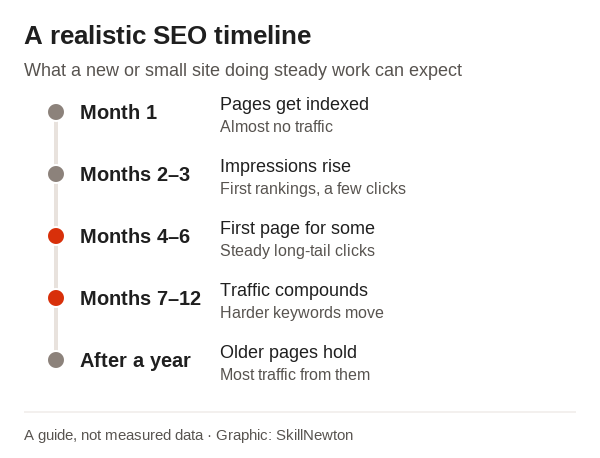
| Period | What you do | What you can expect to see |
|---|---|---|
| Month 1 | Set up the site, Search Console and GA4; research keywords; fix technical basics | Pages start to be indexed; almost no traffic yet |
| Months 2 to 3 | Publish and optimize pages for low-competition keywords; add internal links | Impressions rise in Search Console; first rankings on pages two and three; a few clicks |
| Months 4 to 6 | Keep publishing; update pages that sit just outside the top 10; earn first links | Some pages reach the first page; steady clicks for long-tail searches |
| Months 7 to 12 | Build depth around your best topics; improve pages that are working; earn more links | Traffic compounds; harder keywords begin to move; enquiries or sales become regular |
| After a year | Maintain, refresh old content, expand into new topics | Older pages hold their positions and bring most of the traffic |
The first sign of progress is usually impressions, not clicks. If impressions in Search Console are rising, Google is testing your pages for more searches, and clicks tend to follow.
What speeds SEO up
- Target low-competition keywords first. Specific, longer searches are easier to win. Our Keyword Research guide explains how to find them.
- Match the search intent. A page that gives searchers the kind of answer they want can rank within weeks.
- Fix technical problems early. A page that cannot be crawled or indexed cannot rank. See the Technical SEO guide.
- Link your pages together. Internal links help Google find new pages and understand them. See the Internal Linking guide.
- Update, do not just wait. Refresh pages that are stuck after six months.
- Work on an existing site if you can. A site with some history usually responds faster than a brand-new domain.
What slows SEO down
- Chasing broad, competitive keywords on a new site.
- Publishing thin pages that add nothing to what already ranks.
- Leaving technical errors unfixed for months.
- Stopping after a few weeks because nothing has happened yet.
- Changing direction every month, so no topic gets enough depth.
- Relying on shortcuts such as bought links, which can get a site penalised.
Does it differ by type of SEO?
| Type of work | How quickly results tend to show | Why |
|---|---|---|
| Fixing technical errors on an existing site | Often within weeks | Google only needs to recrawl pages it already knows |
| Google Business Profile improvements | Often within weeks | Profile changes take effect without building a website's authority |
| New content on an established site | One to three months | The site already has a track record |
| New content on a new site | Three to six months or more | The site has to earn trust first |
| Competitive national keywords | Six to twelve months or more | Older, well-linked pages hold the first page |
These ranges reflect how the work behaves in practice and the studies above. They are not measured figures, so treat them as a rough guide.
What to tell a client or your manager
If you do SEO for someone else, set expectations in the first conversation.
- Say three to six months for first results and up to a year for competitive terms, and quote Google's own four months to a year.
- Agree what will be reported each month before rankings move: pages indexed, impressions, pages published and issues fixed.
- Explain that some pages will rank quickly and some will not, and that you will update the ones that stall.
- Never promise a position or a date. No one controls Google's results.
A clear monthly report makes the waiting period easier for everyone. Our SEO Audit guide covers what to check and record.
Learning SEO takes less time than ranking
People often confuse two timelines. Learning the working basics of SEO takes about six weeks of weekday practice. Seeing a new website rank takes months. So the sensible order is to learn first, start a site early, and let it gather data while you keep practising.
That is how SkillNewton's SEO Foundation & Practical Implementation course is built: 30 live classes, with a live website set up in the first week so that Search Console has data by the time you study analytics. The longer Advanced SEO, AEO & GEO Mastery course runs for 90 classes, which gives a student site several months to start ranking.
If you want depth in one area, see the courses on Technical SEO, Local SEO, SEO Content Strategy and SEO Analytics. No course can promise rankings or a date for them.
Related reading: Is SEO still worth learning in 2026?, SEO salary in India and SEO course fees in India.
The bottom line
Plan for three to six months before SEO shows clear results, and up to a year for competitive searches. Within that, the pages that succeed often do so quickly, and the ones that fail rarely recover by waiting. Pick keywords you can win, build pages that answer the search properly, fix what is broken, and review every page at six months. Time helps, but only when the work is aimed at the right target.
Frequently asked questions
How long does SEO take to work?
Usually three to six months for measurable results, and up to a year or longer in competitive fields. Google's guidance is four months to a year.
How long does it take a new website to rank on Google?
A new site can be indexed within days, but ranking on the first page for useful searches usually takes three to six months or more. Ahrefs found that only 1.74% of new pages reach the top 10 within a year.
Can SEO work in one month?
Sometimes, for low-competition searches or for fixes on an established site. Of the pages that reached the top 10 in Ahrefs' study, 40.82% did so within a month. For a new site and competitive keywords, one month is too short.
Why is my page not ranking after six months?
The usual reasons are a keyword that is too competitive, content that does not match what searchers want, technical problems that block indexing, or too few links. Update the page instead of waiting longer.
Is SEO faster than paid ads?
No. Ads can bring visitors the same day, and stop when you stop paying. SEO is slower to start, and the traffic continues without a cost per click.
Sources
- Search Engine Roundtable: Google: Give SEOs 4-12 Months To See Positive Ranking Benefits, February 2017. Source for Maile Ohye's four months to a year guidance, quoted from Google's video on how to hire an SEO.
- Ahrefs: How Long Does It Take to Rank in Google? And How Old Are Top Ranking Pages? Source for 1.74%, 5.7%, 72.9%, 13.7%, 40.82% and the six-month update advice.
- Ahrefs: How Long Does SEO Take to Show Results? Source for the polls answered by 3,680 people and John Mueller's comment on new sites.
Related posts
SEO Course Fees in India 2026: What You Pay and What You Get
SEO course fees in India run from free to well over ₹1 lakh. Here are the fee bands with sources, the costs that are easy to miss, and a checklist for comparin…
Read postSEO Salary in India 2026: Fresher to Mid-Career
What SEO Specialists and SEO Executives earn in India, from fresher to mid-career, with the latest Payscale and AmbitionBox figures and the skills that raise p…
Read postIs SEO Still Worth Learning in 2026? What the Zero-Click Data Says
Yes, SEO is still worth learning in 2026, but the job has changed. Here is what the latest zero-click, AI Overview, local search and salary data says, with sou…
Read post