
SEO vs AEO vs GEO: What Changed and What Still Works
SEO gets your pages ranked in search results. AEO gets your content quoted as the direct answer. GEO gets your brand named and cited by AI assistants. They are three layers of the same job, not three rival methods, and the first layer still carries the other two.
This post defines each one, compares them in a table, shows the 2026 data behind the shift, and sets out what to work on first.
Key takeaways
- SEO is about ranking, AEO is about being the answer, and GEO is about being cited by AI.
- Google's AI Mode has passed 1 billion monthly users.
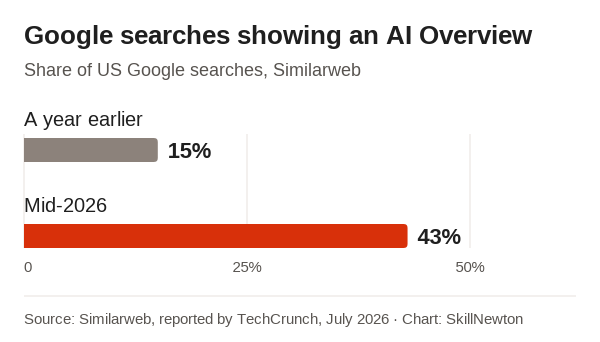
- AI Overviews went from appearing in 15% of searches to 43% in a year, according to Similarweb.
- Only 6.8% of US ChatGPT desktop queries included citations in May 2026, so being cited is still rare.
- Only 11% of domains are cited by both ChatGPT and Perplexity, so each AI tool has to be checked separately.
What each term means
SEO (Search Engine Optimization) is the work of making pages appear and rank in search engine results. It covers keywords, content, technical health and links. The result you want is a click from the results page to your site. Our SEO Basics guide covers the fundamentals.
AEO (Answer Engine Optimization) is the work of shaping content so a search engine can lift it as the direct answer: a featured snippet, a People Also Ask box, a voice reply. The result you want is to be the answer shown, with or without a click. See the AEO guide.
GEO (Generative Engine Optimization) is the work of making your brand and content easy for AI systems to understand, trust and cite when they write an answer. That includes Google's AI Overviews and AI Mode, ChatGPT, Gemini and Perplexity. The result you want is to be named or linked in the generated answer. See the GEO guide.
The terms are not standardised. Some companies use AEO for everything, and others say AI search optimization. The work is what matters, not the label.
SEO vs AEO vs GEO in one table
| SEO | AEO | GEO | |
|---|---|---|---|
| Goal | Rank in the results | Be the direct answer | Be cited in AI-written answers |
| Where it shows | Organic results, Maps, shopping | Featured snippets, People Also Ask, voice | AI Overviews, AI Mode, ChatGPT, Gemini, Perplexity |
| Unit of work | A page and a keyword | A question and a short answer | A brand, its facts and its mentions |
| What you optimize | Content, technical health, links | Question headings, direct answers, FAQ structure | Entity clarity, consistent facts, third-party mentions, crawler access |
| How you measure it | Rankings, clicks, conversions | Snippets won, answer visibility | Mentions and citations in AI answers |
| Does it need SEO first? | It is the base | Yes | Yes |
Why AEO and GEO matter now
Three sets of numbers explain the shift.
AI answers are now part of ordinary search. Google said at I/O 2026 that AI Mode had passed 1 billion monthly users. Similarweb data reported by TechCrunch shows AI Overviews going from 15% of searches to 43% in a year. Estimates vary by study, but the direction is clear.
Ranking first no longer guarantees the click. Ahrefs found that when an AI Overview appears, the top-ranking page gets about 58% fewer clicks. If the answer is written above your link, you want to be the source it names.
Being cited is still uncommon, which is the opportunity. The same Similarweb report found that only 6.8% of US ChatGPT desktop queries included citations in May 2026, even though responses with citations had grown more than fivefold in a year. And HubSpot, drawing on a 2025 study by Profound, reports that only 11% of domains are cited by both ChatGPT and Perplexity. Few sites are doing this well yet.
What still works: the shared foundation
Most of what makes a page rank also makes it quotable. All three depend on the same base:
- Pages that can be crawled and indexed. An AI system cannot cite a page it cannot read.
- Content that answers a real question. Useful, specific, accurate pages win in every format.
- Clear structure. One main heading, logical subheadings and short paragraphs help both people and machines.
- Trust. A named author, real experience and consistent business details support rankings and citations alike.
- Being mentioned elsewhere. Links and brand mentions on other sites tell search engines and AI systems that you are worth referring to.
This is why SEO is not being replaced. A site with weak SEO has nothing for AEO or GEO to build on.
What is different for AEO
AEO changes how you write, not what you know.
- Put the question in a heading, in the words people use.
- Answer it in the first one or two sentences, then add detail.
- Keep each answer able to stand alone, since it may be shown without the rest of the page.
- Use lists and tables where the answer is a set of steps or a comparison.
- Add FAQ sections for the follow-up questions people ask.
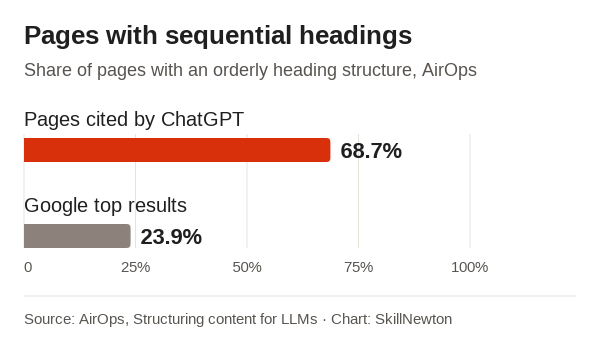
Structure seems to matter to AI systems too. AirOps research found that 68.7% of pages cited by ChatGPT used a sequential heading structure, against 23.9% of Google's top results. Our Structured Data guide covers the markup side.
What is different for GEO
GEO moves the focus from the page to the brand.
- Entity clarity. State plainly who you are, what you do and where, and keep it identical everywhere. See the Entity SEO guide.
- Consistent facts. Prices, names, addresses and claims should match across your site, your profiles and third-party listings.
- Mentions on sites AI systems draw on. Reviews, directories, news coverage and community discussions all feed AI answers.
- Crawler access. Check that your robots.txt does not block the AI crawlers you want to be read by.
- Query fan-out. AI systems split one question into several searches, so cover the related questions around your topic. See the Query Fan-Out guide.
- Testing by prompt. There is no rank tracker for a conversation. You ask the AI tools the questions your customers ask and record what they say.
Because only 11% of domains are cited by both ChatGPT and Perplexity, test each tool separately. Our AI Search Optimization guide goes further.
Which should you work on first?
For almost everyone, the order is SEO, then AEO, then GEO. What changes is how soon you reach the later stages.
| Your situation | Start with | Then add |
|---|---|---|
| New website | SEO basics: indexing, keywords, on-page | AEO structure as you write each page |
| Site with traffic that has fallen since AI Overviews | AEO: rewrite affected pages answer-first | GEO: entity and brand consistency |
| Local business | Local SEO and Google Business Profile | GEO: correct business details across AI tools |
| Online store | Product and category SEO, product schema | AEO for buying questions; GEO for brand mentions |
| Established brand | A technical and content audit | GEO: prompt testing and third-party mentions |
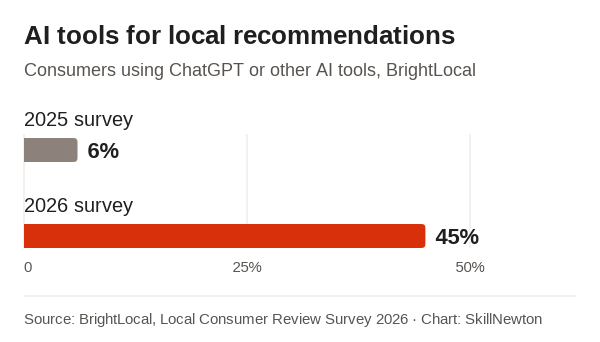
Local businesses should not leave GEO until last. BrightLocal's 2026 survey found that 45% of consumers use ChatGPT or other AI tools for local business recommendations, up from 6% the year before.
Common mistakes
- Dropping SEO to chase AI. The base still decides whether you are found at all.
- Treating GEO as a trick. There is no hidden tag that makes an AI cite you. It is clarity and reputation, built over time.
- Writing for machines only. Pages stuffed with question headings and no substance help nobody.
- Testing one AI tool. Results differ between tools, so check several.
- Expecting guarantees. No one controls what an AI system says. Anyone who promises citations is guessing.
How to measure each one
| Layer | What to track | Where |
|---|---|---|
| SEO | Impressions, clicks, rankings, conversions | Search Console and GA4 |
| AEO | Featured snippets and People Also Ask appearances for your target questions | Manual checks and SEO tools |
| GEO | Whether your brand is mentioned or cited for a fixed set of prompts, and whether the facts are right | A prompt log, re-run monthly across ChatGPT, Gemini and Perplexity |
Keep the prompt set the same each month so you can compare results over time.
Learning all three
SkillNewton's Advanced SEO, AEO & GEO Mastery course teaches the three together across 90 live classes, with separate modules on AEO and GEO and a GEO and AEO visibility audit as one of its 12 projects. It starts from the basics, so beginners can join.
If you want a shorter start, the SEO Foundation & Practical Implementation course covers the SEO base in 30 live classes and introduces AEO and GEO. For related skills, see AI SEO & SEO Automation, SEO Content Strategy & Semantic SEO and Local SEO & Google Business Profile.
No course can promise rankings or AI citations. For the wider picture, read Is SEO still worth learning in 2026?
The bottom line
SEO, AEO and GEO are one job seen at three distances: the page, the answer and the brand. SEO gets you found, AEO gets you quoted, and GEO gets you named when an AI writes the reply. Start with solid SEO, write every page answer-first, keep your brand facts consistent everywhere, and test what the AI tools say about you each month.
Frequently asked questions
What is the difference between SEO, AEO and GEO?
SEO improves how pages rank in search results. AEO shapes content so search engines can show it as a direct answer. GEO improves how AI assistants such as ChatGPT, Gemini and Perplexity mention and cite a brand.
Is GEO replacing SEO?
No. GEO depends on SEO. An AI system can only cite pages it can crawl, understand and trust, and those are the same qualities SEO builds.
Is AEO the same as GEO?
Not quite, though the terms overlap and some companies use one word for both. AEO focuses on being shown as a direct answer in search features. GEO focuses on being cited in answers written by AI systems.
How do I get cited by ChatGPT?
Publish clear, factual, well-structured answers, keep your brand details consistent across the web, earn mentions on trusted sites, and make sure AI crawlers can read your pages. No method guarantees a citation.
Do I need to learn GEO as a beginner?
Learn the SEO basics first, then AEO and GEO. They are easier to understand once you know how pages are crawled, indexed and ranked.
Sources
- Google: I/O 2026: Welcome to the agentic Gemini era. Source for AI Mode passing 1 billion monthly users.
- TechCrunch, reporting Similarweb data: Google's AI search is rapidly becoming the default, new data shows, July 2026. Source for AI Overviews rising from 15% to 43% of searches, the 6.8% citation figure and the fivefold growth.
- Ahrefs: Update: AI Overviews Reduce Clicks by 58%, February 2026.
- HubSpot: How to Optimize Content for ChatGPT, citing Profound's citation overlap study (2025). Source for the 11% figure.
- AirOps: Structuring content for LLMs. Source for 68.7% and 23.9%.
- BrightLocal: Local Consumer Review Survey 2026. Source for the 45% and 6% figures.
Related posts
How Long Does SEO Take to Work? What the Ranking Data Shows
SEO usually takes three to six months to show results, and longer in competitive fields. Here is what Google says, what the ranking studies show, and a realist…
Read postSEO Course Fees in India 2026: What You Pay and What You Get
SEO course fees in India run from free to well over ₹1 lakh. Here are the fee bands with sources, the costs that are easy to miss, and a checklist for comparin…
Read postSEO Salary in India 2026: Fresher to Mid-Career
What SEO Specialists and SEO Executives earn in India, from fresher to mid-career, with the latest Payscale and AmbitionBox figures and the skills that raise p…
Read post